Repository Pattern: It's Not For You, It's For the Next Developer
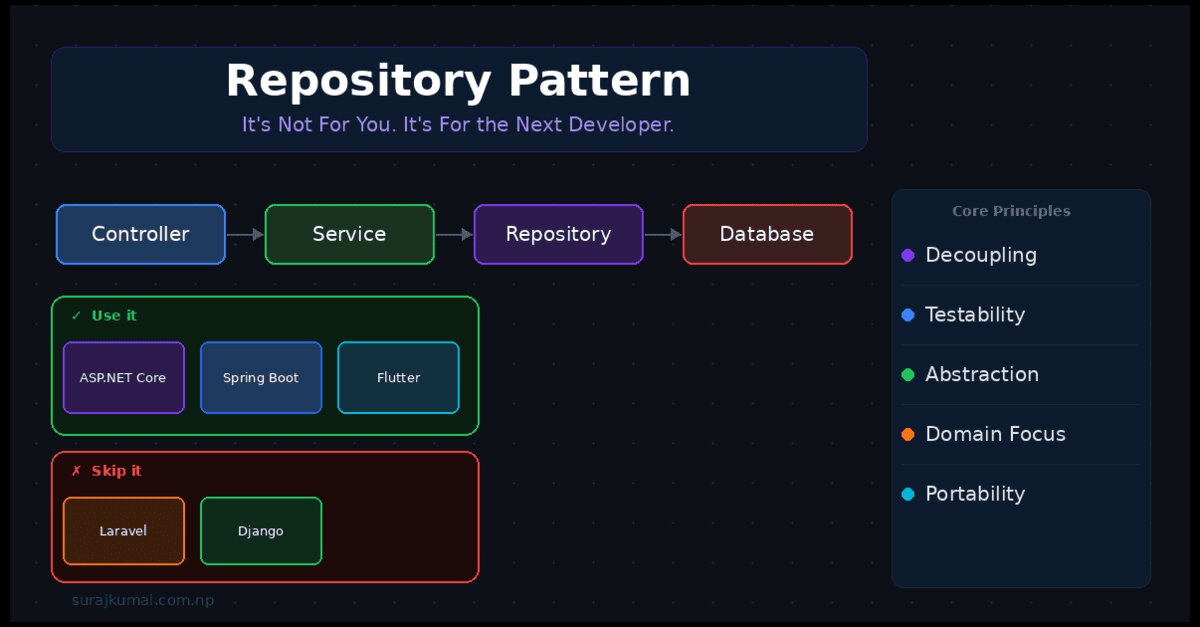
Every developer has read at least one blog post that says "always use the repository pattern." Clean architecture. Separation of concerns. Testability. Abstraction. The words sound right. The diagrams look clean.
Then you open a Laravel project someone "properly architected" and you're three interfaces deep just to fetch a user from the database.
The repository pattern is not universally good or universally bad. The framework you're working in already has an opinion about whether you need it. The question is whether you're listening.
What Is the Repository Pattern
At its core the repository pattern puts a layer between your business logic and your data access logic. Instead of your service or controller talking directly to the database, it talks to a repository. The repository handles the actual querying.
The idea is that your business logic should not care whether data comes from a MySQL database, a PostgreSQL database, an API, or a flat file. It just asks for data and gets data back.
Controller → Service → Repository → DatabaseInstead of:
Controller → Service → Database directlyThe components you typically see in a full repository pattern implementation:
1. Model — represents the data structure. In most ORMs this maps directly to a database table.
2. DTO (Data Transfer Object) / Data Mapper — carries data between layers without exposing your internal model directly. Useful when your database schema and your API response shape are different things.
3. Repository Interface — defines what operations are available. findById, findAll, save, delete. The interface is the contract.
4. Concrete Repository — implements the interface. This is where the actual database query lives.
5. Service — contains business logic. Calls the repository to get or save data. Does not know or care how the repository works internally.
6. Controller — handles the HTTP layer. Calls the service. Returns a response.
7. UI — Template Engines like Blade, Razor pages, Jinja etc. In frontend frameworks like Flutter, the UI calls the repository through a provider or BLoC. Never queries data directly.
Where It Makes Sense
ASP.NET Core
C# basically nudges you toward the repository pattern whether you plan to use it or not.
The language has interfaces built into its core. Dependency injection is not an afterthought — it is the entire philosophy of ASP.NET Core. You register services in Program.cs and inject them everywhere. The framework expects this pattern.
// Interface
public interface IUserRepository
{
    Task<User?> GetByIdAsync(int id);
    Task<IEnumerable<User>> GetAllAsync();
    Task SaveAsync(User user);
}

// Concrete implementation
public class UserRepository : IUserRepository
{
    private readonly AppDbContext _context;

    public UserRepository(AppDbContext context)
    {
        _context = context;
    }

    public async Task<User?> GetByIdAsync(int id)
    {
        return await _context.Users.FindAsync(id);
    }

    public async Task<IEnumerable<User>> GetAllAsync()
    {
        return await _context.Users.ToListAsync();
    }

    public async Task SaveAsync(User user)
    {
        _context.Users.Update(user);
        await _context.SaveChangesAsync();
    }
}

// Register in Program.cs
builder.Services.AddScoped<IUserRepository, UserRepository>();
When I built Snapwrite - a document editing platform with WYSIWYG integration, authentication, and client-side document downloads - I used this pattern throughout. Coming from Laravel and Next.js, ASP.NET felt like a stricter environment. More structured. More explicit.
Honestly? C# is what TypeScript wanted to be. The type system, the interfaces, the dependency injection - it all made the repository pattern feel natural rather than forced. The language itself was pushing in that direction.
Java Spring Boot
Spring Boot is built entirely around dependency injection. The @Repository, @Service, @Controller annotations are not just labels — they are the architecture. Spring expects you to separate these concerns and provides tooling that assumes you have.
// Repository interface extending JpaRepository
public interface UserRepository extends JpaRepository<User, Long> {
    Optional<User> findByEmail(String email);
    List<User> findByActiveTrue();
}

// Service layer
@Service
public class UserService {
    private final UserRepository userRepository;

    public UserService(UserRepository userRepository) {
        this.userRepository = userRepository;
    }

    public User getUserById(Long id) {
        return userRepository.findById(id)
            .orElseThrow(() -> new UserNotFoundException(id));
    }
}
Spring Data JPA generates the concrete implementation at runtime. You define the interface, Spring handles the rest. The repository pattern here is not overhead — it is the path of least resistance.
Flutter
Flutter is where the repository pattern genuinely saved a project I was working on.
The app was a trucking platform for an American client. Three roles baked into a single Flutter app — truckers, hirers, and truck owners. Each role had its own authentication flow, its own profile setup, its own screens and data requirements.
A collaborator joined mid-project to handle profile picture uploads to AWS S3. He was able to find his way around the codebase and integrate his feature without needing a guided tour of every file. The repository layer gave the codebase a clear map. Data access here. Business logic here. UI here.
Without clean architecture that codebase would have been API calls inside widgets, state management scattered across files, no clear boundary between what fetches data and what displays it. Nobody would have found their way around it.
// Repository interface
abstract class UserRepository {
  Future<User> getUserById(String id);
  Future<void> updateProfileImage(String userId, File image);
}

// Implementation
class UserRepositoryImpl implements UserRepository {
  final ApiService _apiService;
  final AwsStorageService _storageService;

  UserRepositoryImpl(this._apiService, this._storageService);

  @override
  Future<User> getUserById(String id) async {
    final response = await _apiService.get('/users/$id');
    return User.fromJson(response.data);
  }

  @override
  Future<void> updateProfileImage(String userId, File image) async {
    final imageUrl = await _storageService.uploadImage(image);
    await _apiService.patch('/users/$userId', {'profileImage': imageUrl});
  }
}
For a simple Flutter app with one API call — a single screen fetching a list — you probably do not need this. It is fine to call the API directly. But once your app has multiple roles, multiple collaborators, or multiple data sources, the repository pattern stops being overhead and starts being the thing that keeps everyone sane.
Where It Is Overkill
Laravel
Laravel does not need the repository pattern. This is not a controversial opinion among experienced Laravel developers — it is the natural conclusion of understanding what Eloquent actually is.
Eloquent is already an abstraction over the database. When you write:
User::where('active', true)->with('roles')->get();That is already clean. That is already readable. That is already expressive. Adding a repository layer on top:
$this->userRepository->getActiveUsersWithRoles();You just wrapped a perfectly readable ORM call inside an unnecessary method. You did not add abstraction. You added indirection. Now when someone new joins the project they have to find the repository class, find that method, and read the Eloquent query inside it — the query they could have just read directly.
My preferred structure in Laravel:
Controller → Service → Model (Eloquent directly)With middleware handled at the route level and policies for authorization:
// Routes
Route::middleware(['auth', 'verified'])->group(function () {
    Route::get('/dashboard', [DashboardController::class, 'index']);
});

// Controller — thin, handles HTTP only
class UserController extends Controller
{
    public function __construct(private UserService $userService) {}

    public function update(UpdateUserRequest $request, User $user)
    {
        $this->authorize('update', $user);
        return $this->userService->update($user, $request->validated());
    }
}

// Service — business logic lives here
class UserService
{
    public function update(User $user, array $data): User
    {
        $user->update($data);
        return $user->fresh();
    }
}
Validation is handled by Form Requests. Authorization is handled by Policies. Middleware is declared on routes. The framework already gave you every separation of concern you need.
The other reason Laravel does not need the repository pattern is the ecosystem. When you need OAuth you use Socialite or Passport — first party packages maintained by the Laravel team, tested against the framework, updated with every release. When you need payments you use Cashier. When you need search you use Scout.
This is not npm where a single developer maintains an is-Odd package that half the internet depends on. Laravel's ecosystem is curated and trusted. You are not abstracting away an unreliable third party dependency. You are using tools that were built specifically for the framework you are in.
Django
Django's app structure is already the separation of concerns.
A Django project is not one monolithic codebase — it is a collection of apps. Each app is its own isolated unit with its own models, views, serializers, and URLs. The auth app has no idea what the posts app does. The posts app has no idea what the payments app does. The boundary is enforced at the structural level, not through a pattern you layer on top.
myproject/
  auth/
    models.py
    views.py
    serializers.py
    urls.py
  posts/
    models.py
    views.py
    serializers.py
    urls.py
  payments/
    models.py
    views.py
    serializers.py
    urls.py
Every property the repository pattern promises — decoupling, testability, abstraction, domain focus — Django's app architecture already delivers. The auth app is decoupled from posts by design. Each app is independently testable. Each app owns its own data access and business logic.
Adding a repository layer on top of this is abstracting something that is already abstracted. You would be introducing an extra indirection into a codebase that already has clear boundaries.
Services can still live inside individual apps for complex business logic. Tasks handled by Celery, signals, and other utilities fit naturally within their respective apps. The separation of concerns is already there — Django just calls it an app instead of a repository.
The Real Value Nobody Talks About
Every blog post about the repository pattern talks about testability, abstraction, and swapping databases.
Here is the honest version:
You are almost certainly never going to swap your MySQL database for MongoDB mid-project. The testability argument is valid but Laravel factories and in-memory SQLite already solve that without a repository layer.
The real value of the repository pattern is communication.
A well structured repository layer tells the next developer — or your collaborator joining mid-project to add AWS uploads — exactly where to look. Data access is here. Business logic is there. UI is somewhere else entirely. The architecture explains itself so you do not have to.
That is what happened with the trucking app. The repository pattern was not there for me. It was there for the developer who joined later and needed to find his way around a codebase he had never seen.
That is the actual discipline behind the pattern. Not the abstraction. Not the testability. The fact that code is read far more than it is written — and the next person reading it deserves a map.
The Framework Already Told You
Before you decide whether to use the repository pattern, look at what the framework is already doing.
ASP.NET Core — interfaces and DI containers are first class citizens. The framework is built around injection. Use the repository pattern.
Spring Boot — @Repository, @Service, @Controller are architectural annotations not labels. Spring expects this separation. Use the repository pattern.
Flutter at scale — clean architecture is the community standard for a reason. Multiple roles, multiple developers, multiple data sources. Use the repository pattern.
Laravel — Eloquent is the abstraction. Form Requests handle validation. Policies handle authorization. Middleware handles cross-cutting concerns. The framework already gave you the architecture. Skip the repository pattern.
Django — QuerySets are expressive and clean. The ORM is the pattern. Skip the repository pattern.
The pattern is not universally right or universally wrong. The language and framework you are in have already made an opinion. The discipline is knowing when to follow it and when to step back and let the framework do its job.
If you have thoughts or disagree with any of this - especially the Laravel take - feel free to leave me a mail. These are opinions built from real projects, not absolutes.
Do you like the post?
You can mail me at [email protected]
I post blogs—feel free to send feedback, suggestions, or just connect.
print(read_more_blogs)
print(back_to_portfolio)